
Masterbatch and compounding work is normally built on one of three pelletizing routes. The choice follows the additive, the pellet you need and whether the compound can touch water.
Strand pelletizing — filled, blended and fibre-reinforced compounds
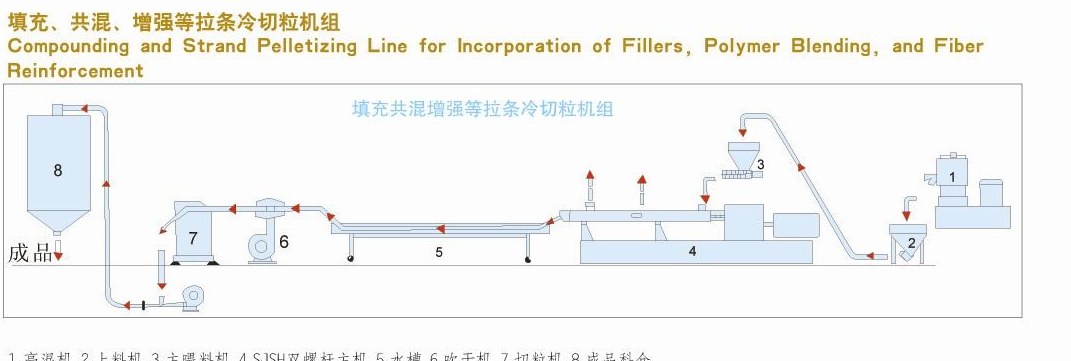
The standard route for glass- and carbon-fibre reinforcement, PC+ABS and similar alloys, high-concentration colour masterbatch, flame-retardant and functional masterbatch, and cable insulation and sheathing compounds.
Air-cooled hot-face pelletizing — heat-sensitive and lightly filled masterbatch
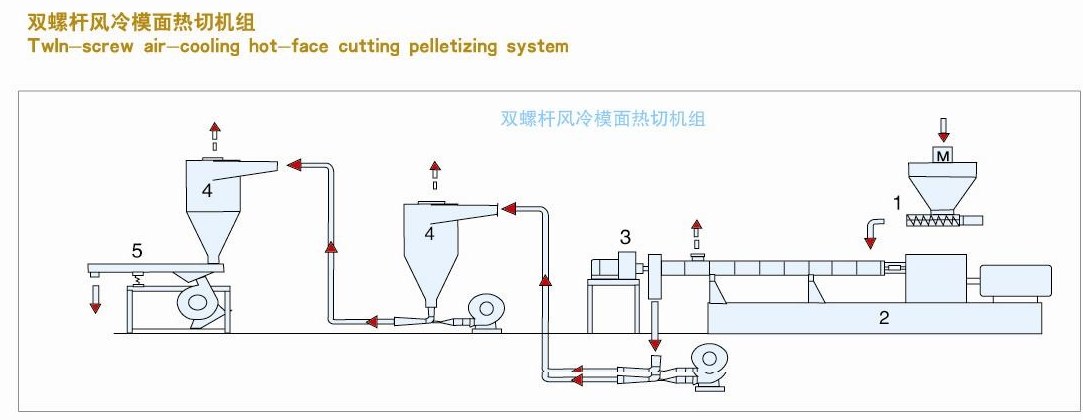
Used for reinforcing modification of PE and EVA with calcium carbonate, talc, titanium dioxide and carbon black; starch-based degradable masterbatch; and flame-retardant masterbatch with antimony trioxide, magnesium hydroxide or aluminium hydroxide.
Water-ring hot-face pelletizing — filled systems at higher output
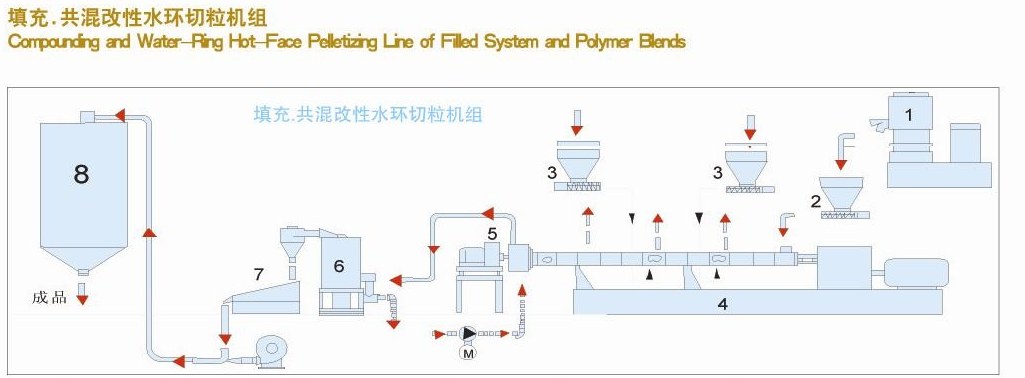
Suited to colour concentrates, flame-retardant masterbatch, TPR and TPU elastomers, EVA and hot-melt adhesives, and PPR or crosslinked-pipe compounds.
Reference output by masterbatch type
| Type | 20 | 35 | 50 | 65A | 75A | 95 | 132 |
|---|---|---|---|---|---|---|---|
| Colour masterbatch | 2–10 | 30–50 | 80–150 | 150–250 | 250–350 | 500–750 | 500–1100 |
| Black masterbatch (carbon black) | 2–8 | 30–40 | 50–100 | 150–220 | 220–320 | 400–700 | 600–1100 |
| Flame-retardant masterbatch | 2–10 | 30–60 | 100–180 | 200–300 | 350–450 | 800–1100 | 1000–1800 |
| Degradable (starch) masterbatch | 2–10 | 30–50 | 90–150 | 150–200 | 200–350 | 600–800 | 600–1200 |
| Mineral-filled compound | 2–10 | 30–60 | 100–200 | 200–400 | 300–550 | 700–1000 | 1100–1800 |
| Glass- or carbon-fibre reinforced | 1–8 | 30–80 | 100–180 | 180–300 | 250–450 | 550–900 | 900–1800 |
| Polymer blending and alloying | 2–10 | 25–60 | 80–180 | 160–250 | 300–400 | 600–1000 | 800–1800 |
Output in kg/h by SJSH screw size in mm. Catalog reference values — indicative and formulation-dependent.